The costly limits of the "Trial and Error" method
Designing a temperature-controlled packaging system for a life-saving drug or a high-value diagnostic kit is a critical operation. Traditionally, the industry has always relied on a physical iterative process: once the isothermal container is designed and built (perhaps as a first prototype) based on previous experience, repeated tests are conducted in a climate chamber using variable quantities of refrigerants until the desired results are achieved, hoping that the useful space for the product is large enough. This approach is not only incredibly expensive but also unacceptably slows down the time-to-market for urgent logistical solutions.
The Virtual Cool Chain revolution
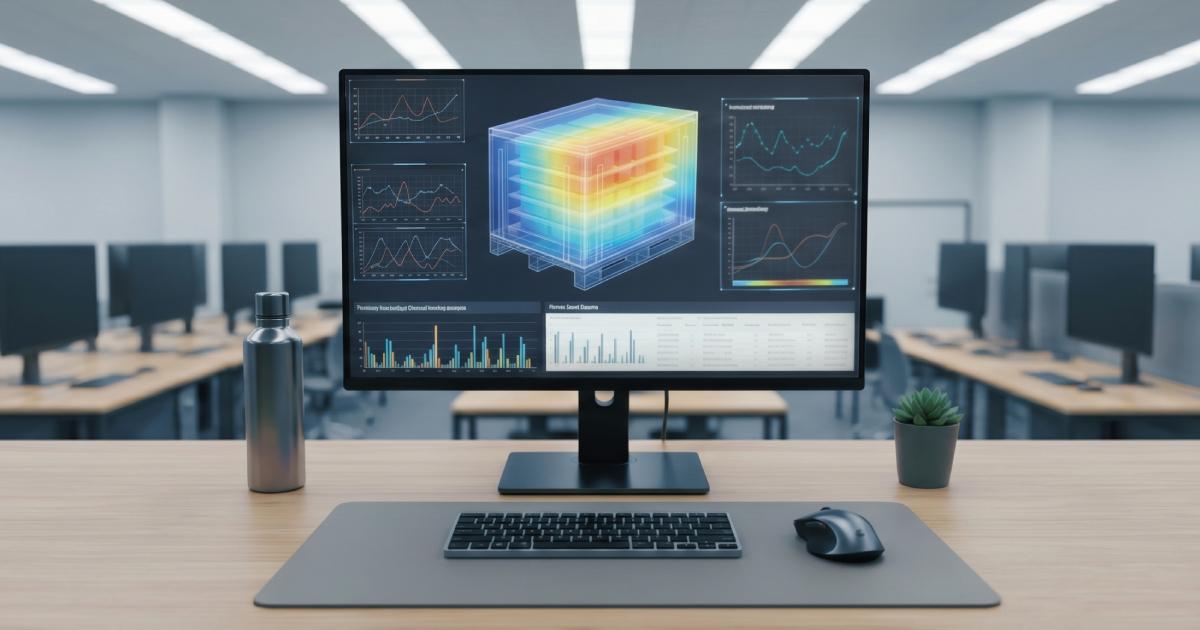
At Dryce, for the past 10 years, we have changed the paradigm by prioritizing CAE (Computer-Aided Engineering) simulation tools over physical tests. Through our Virtual Cool Chain, technicians at the Dryce Lab-Center use sophisticated 3D thermodynamic simulation software to create a true "Digital Twin" of the packaging to undergo virtual tests that simulate real environmental conditions encountered during transport. Climate databases and collected information also allow us to determine the thermal profiles to which the mathematical model of the packaging will be subjected.
What does the Digital Twin tell us?
The simulation calculates with extreme precision variables that the human eye or empirical tests struggle to identify:
Mapping of convective flows: How air moves inside the packaging.
Thermal bridges: Identifying structural weak points that cause thermal dispersion.
PCM Optimization: This allows us to optimize the dosage and positioning of the conditioning devices to be inserted into the packaging. This avoids the costly and logistically burdensome practice of unnecessarily "oversizing" the refrigerant masses and the packaging dimensions (adding weight and transport costs).
From simulation to validated reality
We can virtually test the dreaded "Tarmac Time" (the time the pallet spends on the runway, under the scorching sun or in the freezing cold). The temperature curves generated by our software overlap almost perfectly with the real data subsequently recorded in our validated climate chambers. Only when the algorithm confirms success do we move on to physical prototyping and field trials, providing our users with a complete technical dossier.

-medium.jpg)